
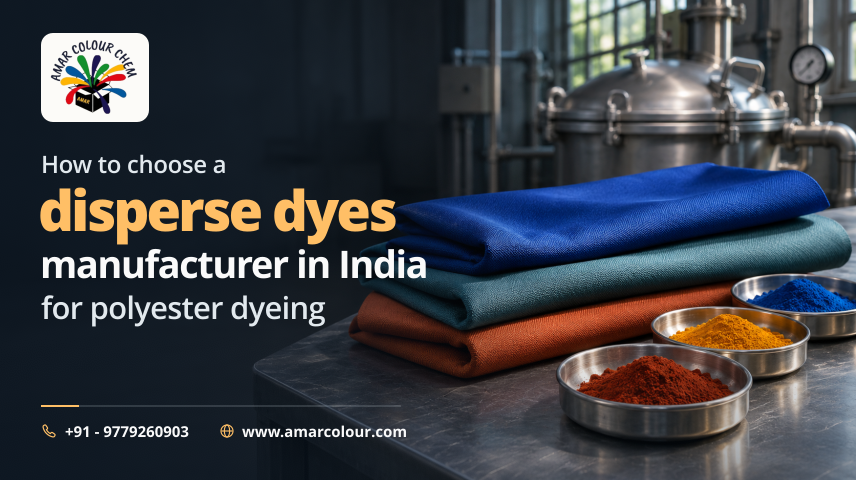
Choose a disperse dyes manufacturer in India by checking how its dyes perform on your polyester fabric, whether repeat lots match the standard and what evidence it provides for each grade. Start with your dyeing method, target shade and finished fabric requirements. Then compare suppliers through a lab dip and a controlled production trial. This gives your dyehouse and procurement teams a common basis for assessing shade accuracy, colour fastness, supply reliability and the cost of producing saleable fabric.
Start with the polyester fabric and dyeing method
Tell each shortlisted supplier what you dye, how you dye it and what the material must withstand after dyeing. A mill producing polyester sportswear faces different requirements from a yarn dyer or a manufacturer supplying curtain fabric. Share the fibre composition, fabric or yarn construction, target shade, shade depth, machine type and finishing sequence. Include the approved swatch, customer specifications and expected order volume so suppliers can recommend comparable grades.
For high-temperature exhaust dyeing, polyester mills commonly work at around 130 °C in pressurised equipment. Give the supplier your actual liquor ratio, temperature profile and auxiliaries so it can assess compatibility. If you use a continuous thermosol line, ask for recommendations based on your drying and fixation conditions. For polyester blends, explain how you colour the other fibre and whether you need to limit staining on cotton, elastane or another companion fibre.
Use your regular production substrate for the trial. A lab dip on standard polyester can help narrow the shortlist, but your own microfibre, recycled polyester or textured yarn may deliver a different shade depth or appearance. For products with recurring orders, tell the supplier whether the mill routinely changes fabric sources. That detail helps you decide whether to trial the dye on more than one incoming fabric lot before approving it.
Match the dye grade to the shade and end use
Ask the supplier to explain why it recommends a particular grade. Disperse dyes have limited water solubility and enter polyester during dyeing. As a general rule, lower-energy grades tend to dye quickly and level more readily, while higher-energy grades often offer better sublimation fastness and can require closer control of the heating profile. Compare the data for each product because performance varies within these categories.
For pale greys and other sensitive shades, pay close attention to levelness and the risk of uneven uptake in combinations. For navy and black, check build-up, which describes how much additional depth you gain as you increase the dye dosage. For fabrics that undergo heat setting, printing or bonding, assess shade change and staining after the intended heat exposure. A deep black that passes the initial shade check may still transfer colour to a light trim after finishing.
If you mix dyes to match a target, ask how the components exhaust across the heating cycle. Dyes that strike at different rates can produce a shade that shifts when production conditions vary. Ask the supplier for combination recommendations, then run the complete recipe on your material. A supplier’s individual dye cards can help with selection, but the finished combination is the material your customer will approve.
Examine batch consistency and traceability
Ask how the supplier checks shade, relative colour strength and dispersion before releasing a lot. Specify what you need on the batch-specific Certificate of Analysis (CoA) and ask for reports from recent lots of the same grade. Check that the supplier measures against a stated reference and that the test method and acceptance limits are consistent across reports.
For incoming quality control, compare the lot number on the packaging with the CoA and record it against the dyehouse recipe. Retain a labelled dye sample and a finished fabric swatch from the approved trial where your procedure allows. If a later shipment produces a different shade, you can compare both lots on the same fabric using the same laboratory procedure before changing the recipe.
Confirm which company makes or formulates the grade, which site releases the batch and who will investigate a complaint. If a distributor handles the order, establish how it will trace the package back to the original lot. Ask for advance notice of changes to the formulation, standardised strength or supply site. A change that affects an approved recipe can create extra work across several colourways, particularly when the same dye appears in combinations.
Set fastness requirements before sampling
Start with the customer’s specifications and select tests that reflect how the fabric will be made, worn and cared for. Sportswear may require wash, rubbing and perspiration fastness checks. Curtain and upholstery buyers may prioritise light fastness. If fabric undergoes high-temperature finishing, agree on dry-heat or hot-pressing tests as applicable. Common methods include ISO 105-C06 for laundering, ISO 105-X12 for rubbing, ISO 105-P01 for dry heat and ISO 105-B02 for artificial light.
Check how the supplier generated each result. Ask for the fabric type, shade depth, dyeing and aftertreatment conditions, test method and grading details. A fastness rating from a pale lab sample can offer limited evidence for a deep shade on your fabric. Where the test calls for it, record both the colour change on the specimen and the staining on adjacent materials.
Test the finished sample after the same heat setting, softening or other finishing steps planned for bulk production. Reduction clearing can remove surface dye after dyeing, while later heat exposure can cause some dye to migrate back towards the fibre surface. If a test fails after finishing, compare specimens taken before and after that step to help identify where the performance changed.
Verify documents for the exact product grade
Request the Technical Data Sheet (TDS), Safety Data Sheet (SDS) and a sample CoA for each shortlisted grade. Use the TDS to review application conditions and the SDS to confirm handling, storage and hazard information. Use the CoA to assess a specific lot against the agreed release criteria. Match the trade name, grade and formulation wherever those identifiers appear. Two products can share a Colour Index name while differing in standardised strength or formulation.
If your customer requires ZDHC Manufacturing Restricted Substances List (MRSL) conformance, check the relevant evidence for the product you intend to buy. Verify the scope, validity and required conformance level against the customer’s instructions. The MRSL addresses chemical inputs used in manufacturing. A customer may also apply a Restricted Substances List (RSL) to the finished textile and request results from testing the dyed fabric.
Apply the same product-level check to any OEKO-TEX® claim. ECO PASSPORT covers chemical products within its certification scope, while STANDARD 100 covers tested textile products. Ask which exact dye grade a certificate lists and whether the buyer accepts that evidence. If the buyer requires an independent test report, agree on the laboratory, sample identity and test scope before approving bulk supply.
Run a lab dip, then test on production equipment
Prepare comparable lab dips with the same substrate, target shade and evaluation conditions. Record the dosage of each dye, bath pH, liquor ratio, auxiliaries, heating profile and aftertreatment. Compare the dry samples visually under customer-specified light sources. Use a spectrophotometer where required and agree on the colour difference formula and tolerance before reviewing the results.
Move the strongest candidate to a pilot run or a controlled first bulk lot. Use the production machine and planned finishing route. Compare samples from different points across the fabric width and along the run, or from suitable points within a yarn package. Record levelness, shade, repeatability and operator observations such as deposits or filter loading. Where continuity matters, repeat the trial with a second dye batch.
Record any changes between the lab and production recipe and the reasons for them. A different heating rate, circulation pattern or machine loading can alter the result even when the dye remains the same. If the pilot misses the target, use the trial record to check the likely variables with the supplier before adjusting multiple settings at once. Release the grade for repeat orders once the finished material passes the agreed shade and fastness criteria.
Compare cost per kilogram of saleable fabric
Compare the dye dosage required to reach the same approved shade before you compare prices. Suppose Dye A costs ₹400 per kilogram and needs a 2% dosage on the weight of fabric. The dye costs ₹8 per kilogram of fabric. If Dye B costs ₹500 per kilogram and needs a 1.4% dosage for the same shade, the dye costs ₹7 per kilogram of fabric.
Include differences in auxiliaries, water, steam, clearing and machine time if they affect the comparison. Add any extra cost for shade corrections, repeat testing or reprocessing when you have trial or production data to support the estimate. Divide the total comparable cost by saleable fabric weight to capture the effect of rejected material.
Ask procurement to include freight, pack size, minimum order quantity and the shelf life of unopened stock. A large pack may suit a repeat black recipe and tie up cash on slow-moving shades. When comparing powder and liquid grades, use the dosage of the product as supplied. Confirm the basis of any strength claim and let matched dyeings determine how much product each recipe requires.
Assess delivery reliability and technical support
Ask for separate lead times for samples, regular stock orders and made-to-order grades. Confirm where the supplier stocks the product, how it fulfils repeat orders and what happens if a shipment contains more than one dye lot. If your customer expects closely matched deliveries, decide whether to request a single lot for a production campaign and agree how the supplier will identify each lot on dispatch.
Discuss what happens if bulk production runs off shade. Find out who will review the recipe and request samples, how the supplier handles complaints and what evidence it needs to investigate a lot. A useful first conversation can cover the approved colour standard, fabric identification, recipe, production conditions and samples from before and after finishing.
Keep the commercial and technical approvals in one record. List the exact product designation, agreed strength, CoA requirements, finished fabric tests, delivery terms and approval date. If the supplier proposes a substitute during a stock shortage, use the recorded criteria to decide what to retest. Similar names or a shared Colour Index designation alone provide limited evidence that a substitute will behave the same way in production.
What to send Amar Colour Chem India for a product enquiry
Amar Colour Chem India lists disperse dyes across several shade families, including black, navy, red, orange and violet. Its published range includes a liquid black and identifies Colour Index names or blend descriptions for listed products. When making an enquiry, mention the exact product designation if you already use a particular grade. If you are developing a shade, share the approved swatch and ask which products suit your method.
Include your polyester substrate, dyeing machine, temperature profile, target shade depth, finishing sequence and required fastness grades. State whether you need a powder or liquid grade, how much material you need for the trial and how much you expect to buy if the dye passes. Flag any documents or test reports your customer needs at the enquiry stage so you can review them alongside the technical recommendation.
If you already buy a comparable dye, share the performance criteria it meets and any problem you want the new grade to solve. You might need better lot repeatability, less staining on an adjoining white panel or a shorter and more dependable replenishment lead time. That brief gives technical and purchasing teams a common basis for assessing the sample and deciding whether to schedule a production trial.
Final selection
Approve the dye grade once it meets your shade and fastness requirements on finished fabric, performs consistently on your equipment and comes with the documents your customer requires. Compare the resulting cost per kilogram of saleable fabric and confirm the terms for repeat supply. Keep an approved swatch, the trial recipe and lot details together so the dyehouse can check the next shipment against the same standard.
Frequently asked questions
Which disperse dye grade is best for polyester fabric that undergoes heat setting?
A higher-energy disperse dye is often a good starting point because these grades generally offer better sublimation fastness. Check the individual dye's performance at your shade depth and under your heat-setting conditions. Test the finished fabric for shade change, staining and the fastness properties your customer specifies.
What documents should a disperse dyes manufacturer in India provide?
Request a Technical Data Sheet and a Safety Data Sheet for the exact dye grade, plus a Certificate of Analysis for the supplied lot. If your customer requires ZDHC MRSL conformance or OEKO-TEX® ECO PASSPORT certification, check that the evidence covers the product you plan to buy.
Request a Technical Data Sheet and a Safety Data Sheet for the exact dye grade, plus a Certificate of Analysis for the supplied lot. If your customer requires ZDHC MRSL conformance or OEKO-TEX® ECO PASSPORT certification, check that the evidence covers the product you plan to buy.
Request a Technical Data Sheet and a Safety Data Sheet for the exact dye grade, plus a Certificate of Analysis for the supplied lot. If your customer requires ZDHC MRSL conformance or OEKO-TEX® ECO PASSPORT certification, check that the evidence covers the product you plan to buy.


No comment